Showing posts with label Obama. Show all posts

Tuesday, March 10, 2009

WEEK IN REVIEW: MAR 2-6

Much has transpired over the past two days but I won't get into it yet. Unfortunately, we've been too busy to post the most recent week in review well and on time, but here goes nothing...

The big story in the first days of March was healthcare, an area that needs a whole lot of work. There is no good reason for the all the problems plaguing the medical system in the US. Pharmaceutical and insurance companies continue to rake in billions at the expense of all the rest of us (including many doctors). Unless Obama's healthcare agenda reverses this trend, it will only make matters worse, especially since there is no money to spend. Whatever his plan may be, it will not be easy to fix the problem.

Here's a brief rundown of some things that happened in week nine... 

MONDAY:
 - Obama announced Kathleen Sebelius - a former insurance executive - as his latest pick for Secretary of Health and Human Services. There are still many posts left to fill...

TUESDAY:

 - The President of the United States met with the British Prime Minster... no big deal.
 - Meanwhile, members of Congress debated Obama's massive budget on Captiol Hill
 - In other news the International Criminal Court issued an arrest warrant for Sudanese president Omar Al Bashir. In ambiguously supporting the ICC decision, The president seems to be suggesting that he values justice over peace. If only that were something that applied in other hot zones.

WEDNESDAY:

 - Obama announced plans to overhaul the way that contracts are managed and awarded. While this may seem like bad news for big firms with well-to-do shareholders, it is probably little more than a publicity stunt. 
 - In the evening he hosted members of Congress at the White House in hopes of convincing them to back his budget plans.

THURSDAY:

 - A mass of people attended the White House Forum on Health Reform that lasted all afternoon despite the fact that there is still nobody in charge of that department. Nevertheless, President Obama called for a comprehensive overhaul of the healthcare system (his reforms could cost US taxpayers $2.5 trillion while still leaving over 45 million uninsured) 
 - VP Biden spoke to the AFL-CIO Executive Council in Miami – he reitetreated the WH position that “a strong middle class needs a strong labor movement.” Considering most middle-class workers in the US are not members of any unions, he is probably wrong.
 - While participating in some positive charity work, FLOTUS Michelle Obama had a rather bizarre phot-op at a homeless shelter. 
 - US District Judge James Robertson threw out a lawsuit questioning Obama’s citizenship. He ordered the prosecution to to show why it hadn't violated court rules barring frivolous cases and why the plaintiff' should not have to pay Obama's attorney for wasting his time. Amen to that! Still no news on the other case I keep yapping about.

FRIDAY:
 - Obama spoke at a graduation ceremony for police recruits in Ohio where he sought to justify his gigantic spending bill.
 - Barack toughened his stance on whaling, a move that is sure to upset some people in Japan. I'm not fan of animal cruelty, but I've heard that whale meat is absolutely delicious. 
 - The president announced plans for some more foreign policy appointments... More on this later.
 - Right before the weekend, the White House signaled that limits on stem-cell research would be lifted (more on that some other time).

Sunday, March 1, 2009

WEEK IN REVIEW: FEB 23-27

President Obama started his eighth week in office with a promise to cut the national deficit in half by the end of his first term. Considering the massive spending package he recently signed into law, that may seem a little too optimistic. With time it is becoming ever more clear that despite the dire economic situation we are currently in, our new president intends to spend money we don't have in hopes of making things better. By the end of the week, Barack made his intention to raise the deficit abundantly clear. 

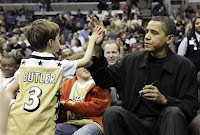
The media highlight of the week was a toss up between an appearance at a Washington Wizards game, and his first 'State of the Union' type speech. It was typical Obama... flourishing rhetoric reminiscent of his campaign days. Unfortunately, the address was quite weak on substance as the Associated Press dutifully pointed out. In many ways, the Republican response was stronger (from a political perspective). While the president sounded more optimistic in discussing what lies ahead, he delivered a laundry list of promises he is unlikely to deliver on them all.

It's too early to pass judgment on the Obama administration's handling of the economic situation, but if his budget proposal is any sign of things to come, there may be real cause for concern. Unsurprisingly, they want to spend a lot of money. Hopes that the stimulus and bailout packages will increase economic growth are probably misplaced. Republicans are gearing up for a fight, and in his weekly video address Obama affirmed his commitment to fight back. There are no real causes for optimism at the time being when it comes to the economy. 

In other news this week, VP Joe Biden presided over the first meeting of the Middle Class Task Force in Philadelphia - the focus was on green jobs. We'll see what actually happens (and how much it costs), but at least the administration appears to be moving in the right direction when it comes to the environment.

Obama laid out his plans for Iraq at Camp Lejeune; among other things, he decided to give the military a little more time to get the job done, electing for a 19 month timeline as opposed to the 16 months he promised while campaign. No big deal really... unless 19 becomes 24 or more. Whatever the case, the military will have its hands full in Afghanistan. It's a rocky road...

Sunday, February 22, 2009

WEEK IN REVIEW: FEB 17-20

Another relatively uneventful week... which culminated with Mr. O's 30th day on the job. As numerous observers have remarked, it almost seems as though he is back on the campaign trail trying to muster support. It's worth mentioning that after a month, he still does not have a Secretary of Commerce or a Secretary of Health and Human Services - that is inexcusable. For those who needed it, we were reminded how far we still have to go before overcoming racism. Things haven't been going to well for him lately... no wonder Junius has been so silent!

As in any week, there were a few notable occurrences. Here are some of them:

Friday, February 20, 2009

BAD TASTE

I hesitated to post it, but people need to see the truth (if they haven't already). I can only see two possible explanations for this cartoon: either those behind it are straight up racists, or it was some sort of a pathetic attempt to comment on the idiotic notion of 'post-racialism.' Maybe the fools at the New York Post who allowed this cartoon to be published were conducting some sort of experiment. But probably not.

Protesters took to the street after a worthless apology. Some people are either unwilling or incapable of admitting their flaws. Here is what the editor in chief had to say about it:
The cartoon is a clear parody of a current news event, to wit the shooting of a violent chimpanzee in Connecticut. It broadly mocks Washington’s efforts to revive the economy.
Sounds like a load of crap to me... Whatever their true motives, they must have known it would be offensive to most people. Clearly they did not care. Many of the newspaper's employees are understandably upset.

While the cartoon immediately touched a nerve for me, that would not have been true if W was still president. He was always depicted as some sort of apish buffoon... and that was cool.

I don't see the value in this "politically correct" culture of ours. It only leads to increased naivety and a false sense of reality. Most political cartoonists are feeling the need to be overly cautious. There is a good reason for that - this country is still not over its issues with race. Excessive caution is unfortunate but also understandable. Even I am willing to tolerate it sometimes.

The monkey cartoon is distasteful and it is racist (by US standards), but in an ideal world it would not be a problem. We don't yet live in an ideal world... even if there is a Black man in the White House.

I'd be curious to hear what he has to say about this whole thing.

Sunday, February 15, 2009

WEEK IN REVIEW: FEB 9-13

In his third full week as president, it seemed as though all Barack Obama's attention was focused on the worsening economic crisis. 37 million viewers tuned into his first primetime press conference where he hoped to drive his message home. It was more exciting than most of his previous appearances as president, but the bar was set pretty low.

There were several other television appearances throughout the week. He smiled for cameras from Indiana to Florida as he sought to reiterate his resolve to the American people. (He also traveled to Illinois to address the workers who help maintain the brutal occupation of Palestinians in the West Bank.)

Fortunately for Obama, his people run Congress - it mattered not that every Republican in the House of Representatives voted against the bill. Things in the Senate were a little more interesting... the vote was held open for over five hours as a handful of staffers waited for Senator Brown to return from his mother's wake to seal the deal.

Understandably, a big deal was made of Lincoln's bicentennial. Obama took to the cameras again and delivered another one of his speeches.

The biggest hit he took came from Republican Senator Judd Gregg who withdrew from consideration for Secretary of Commerce, citing "irresolvable conflicts" with Obama and his polices. Although Bill Richardson stepped away because of a scandal, Gregg left for political reasons further damaging the president's efforts at bi-partisanship. Even if he is planning to exit on a high note, the significance of Gregg's withdrawal should not be underestimated - it served as a rallying point for Republicans and fiscal conservatives of all stripes.

Not much happened on the foreign policy front... The White House must have watched the outcome of the Israeli elections with apprehension... Richard Holbrooke traveled around Afghanistan where he was greeted by a series of suicide bombings... Pakistan also remained in the adminstration's crosshairs... Later in the week, rumors emerged of potential Russian cooperation on the much disputed missile defense shield...

On the national security front, the adminstration began a sweeping cybersecurity review. True to form, the Democrats are getting their hands dirty in all facets of government... I'm not hopeful about this stimulus, especially considering the money needed to pay for it is not available. Either Obama and the nation will emerge victorious when it's all said and done, or his party will screw things up so badly that voters will turn to their other alternative which is equally bad.

We need real change we can believe in...

Tuesday, February 10, 2009

QUITE A MOUTHFUL

President Obama gave a major press conference on Monday night (prime-time on the east coast). He was discussing the dire straights of the national economy and the steps he feels need to be taken in order to make things better. As the Senate prepares to vote on its version of the stimulus package, Barack took to the airwaves to defend his, and he did so with more passion that usual. Although it was slightly overdue, it was another solid oratory performance. Here are some of the more notable excerpts:
It is only government that can break the vicious cycle where lost jobs lead to people spending less money, which leads to even more layoffs.  And breaking that cycle is exactly what the plan that’s moving through Congress is designed to do... 
 
Tax cuts alone cannot solve all our economic problems – especially tax cuts that are targeted to the wealthiest few Americans.  We have tried that strategy time and time again, and it has only helped lead us to the crisis we face right now...
 
More than 90% of the jobs created by this plan will be in the private sector... 
 
The plan that ultimately emerges from Congress must be big enough and bold enough to meet the size of the economic challenge we face right now.  It is a plan that is already supported by businesses representing almost every industry in America; by both the Chamber of Commerce and the AFL-CIO... It also contains an unprecedented level of transparency and accountability, so that every American will be able to go online and see where and how we’re spending every dime... 
 
My administration inherited a deficit of over $1 trillion, but because we also inherited the most profound economic emergency since the Great Depression, doing too little or nothing at all will result in an even greater deficit of jobs, incomes; and confidence.  That is a deficit that could turn a crisis into a catastrophe.  And I refuse to let that happen.
A good speech, but not without its flaws. First of all, I don't understand how the government can be the only one that can "break the vicious cycle" we're in. There are many who believe the government was directly to blame for the predicament we find ourselves in today. And although Obama later implied that Republicans and the previous administration were responsible for the mess he inherited, most experts agree that many of the problems began the last time we had a Democrat in office.

Obama justified the size of the bill by saying that it had been approved by businesses of all sectors, and union bodies. Like most 'liberals' the president is major supporter of unions who simply do not represent the American working class as we are intended to believe. Unfortunately, reporters often fail to point that out when given a chance.

As in any press conference, the fun part came when the questions began. Our new president is not as entertaining as his predecessor, but watching him interact with the press is starting to become more amusing.

The first question came from the Associated Press, and it was related to the economy. Obama talked about politicians who are philosophically opposed to any form of government intervention in financial matters. He went on to defend the massive tag on the stimulus package, adding that "it wasn't some random number I just plucked out of a hat." He said that TARP funding should be conditioned on financial restraint, but he provided no clear guidelines as to how that could be achieved. 

A couple other comments on the economy stuck out, such as his claim that "consumer spending did not get us into this mess" but banks taking on major risks. I would't argue with that, but I wouldn't dismiss consumer spending as irrelevant either - there are millions of people who simply bought more than they could afford. Nevertheless, it is ultimately the system that poses the biggest problem, and we aren't hearing of any major efforts to change the fundamental weaknesses in that system. Maybe Tim Geithner will impress, but that seems doubtful. This administration has so much on its plate that it is bound to screw up in some way.

Luckily some of the correspondents took advantage of the opportunity to ask foreign policy questions, most of which were total softballs. Even though it was coated in sugar, we heard the same stuff about Iran that W used to say. We also heard the president reiterate the importance he sees in Afghanistan, calling it a "big challenge" and admitting that he does not know how long he will have troops in there tearing it up. But the highlight of it all came when he called on veteran reporter Helen Thomas. Once again she gave him his toughest challenge and he failed miserably...

Oh well, the focus was on the economy. 

Still, I'm not feeling this president at all right about now.

Monday, February 9, 2009

DISAPPOINTING...?

[UPDATE BELOW]
Today, a DOJ lawyer appearing before the Ninth Circuit Court of Appeals on behalf of President Obama did something which is already upsetting many, many people. For years, liberals fumed over the Bush administration's invocation of the "state secrets privilege" to prevent courts from hearing cases related to its "extraordinary rendition" program, by which the US has turned over detainees for harsh interrogation in other countries. Many tied this program directly to former President Bush, given his shameful policy on the harsh treatment of detainees in American custody, and expected extraordinary new transparency regarding this program once President Obama took office. However, today the DOJ lawyer mentioned above made clear that the government was still invoking the state secrets privilege in seeking the dismissal of a claim related to extraordinary rendition.

This is a real punch to the gut for left-leaners and libertarians who championed Obama. To their minds, his election meant a 180 degree turn from the Bush administration's detention policy, including extraordinary rendition. And justifiably so - Obama was unequivocal in his denunciation of torture and his promise that it would not occur under his administration. This is why his first executive orders closing Guantanamo, ensuring compliance with the Geneva Convention and starting a review of detention policy were so promising. Many will ask why Obama would stop short with extraordinary rendition, a seemingly inhuman practice that should be cast into the waste bin of history along with other Bush-era practices.

Granted. Having not heard the other side of the argument (since the government refuses to give it on national security grounds), this is a deeply troubling decision - one would think that a victim of rendition should get his day in court. A few things should be remembered, though. First: extraordinary rendition was not a policy begun by George W. Bush - it has been used since the early 1990s. As such, rendition is much more of a staple of American foreign policy than liberals may want to admit. Second, a lower federal district court has already reviewed the classified information forming the basis for the DOJ's privilege claim, and found that the claim was well-founded. The lawyer today reminded the Ninth Circuit of this fact:
What the A.C.L.U. is asking, he said, is that the case be allowed to go forward, giving the courts a chance to decide, based on classified information revealed solely to the judge, what should be allowed to be discussed.

But Mr. Letter said that the lower court judge, James Ware, did receive classified information and came to the correct conclusion in dismissing the case last year. He urged the judges to pore over the same material, and predicted “you will understand precisely, as Judge Ware did, why this case can’t be litigated.”
I doubt this is the last we'll hear of this decision. The Ninth Circuit still has to rule on the ACLU's appeal of dismissal, and should they affirm (as I expect they will), there is little doubt that the ACLU will file an appeal with the Supreme Court.

For my part, ambivalence is the word of the day. I'm hesitant to really call Obama out on this. Yes, it certainly does not fit with his campaign rhetoric, and that's unfortunate. But on the other hand, campaigning and governing are two different things, and I'm inclined to trust the Obama administration when they say that the state secrets privilege is genuinely necessary in this case. Plus, this decision doesn't mean that rendition is actually ongoing (though whether it is is anyone's guess) - it simply means that a case involving rendition will not be heard by the courts. I hope the administration has an extremely good reason for this, and further, I hope that it decides to terminate an egregious and hypocritical practice which, along with even worse abuses by the Bush administration, has tarnished America's reputation in the world.

UPDATE: Marc Ambinder over at the Atlantic had an excellent article today about why the Obama administration made this call. The explanation is exactly what one would expect out of an administration that, so far, has shown itself to be prudent, patient and practical. A quick summary:
Officials decided that it would be imprudent to reverse course so abruptly because they realized they didn't yet have a full picture of the intelligence methods and secrets that underlay the privilege's assertions, because the privilege might correctly protect a state secret, and because the domino effect of retracting it could harm legitimate cases, both civil and criminal, that are already in progress.

"If you decide today precipitously to waive this privilege, you can't get it back," an administration official said. "If you decide to assert it, you can always retract it in the future."

Saturday, February 7, 2009

WEEK IN REVIEW: FEB 2-6

Without a doubt, the honeymoon is over...
President Obama's third week in office seemed to have been his worst yet. He had been hoping to push his monstrous stimulus package through Congress. There was some 'progress' early on, but after a very long Friday, the Senate adjourned after having accomplished nothing of any real significance. It seems there is no shortage of problems with the proposed legislation; it is a weak attempt at a quick fix with potentially devastating long-term consequences. Barack stepped up the rhetoric in an effort to get the bill approved. Something is likely to pass next week... then we can start looking into the issues affecting its implementation.

But concerns over the ECONOMY were not limited to the stimulus bill:
There were several other important developments that are not directly related to the economy and the current financial crisis:

Saturday, January 31, 2009

WEEK IN REVIEW: JAN 26-30

The first full week of the Obama administration was a bit bipolar - the president had some important victories, as well as a few surprising stumbling blocks. Here's a rundown of the biggest stories in the past five days:

PROGRESS:

• As expected, President Obama's stimulus plan, the American Recovery and Reinvestment Act passed the House of Representatives on Wednesday. However, it received not a single Republican vote, despite the fact that the president watered it down to bring at least some of the Republican caucus on board. Their opposition shouldn’t surprise anyone - any stimulus that does pass is not going to end the recession; the best it can hope to do is keep unemployment lower than it otherwise might be. But of course, if it passes no one will ever know what would have happened without the stimulus - they'll just know unemployment was still high. So the Republicans can make plenty of noise about opposing a "useless" stimulus. A great political move, if an unprincipled one.

• Another legislative victory for liberals came with the president’s signing of the Lilly Ledbetter Fair Pay Act. The law overturned the Supreme Court's 2007 decision in Ledbetter v. Goodyear, which held that a pay discrimination claim based on sex must be brought within 180 days of the first discriminatory payment. Ledbetter, who only became aware of the discrimination years later, argued that each paycheck constituted a new discriminatory act re-triggering the 180-day period for filing of a suit. The Act made her claim law.

• On the financial front, President Obama also suggested decisive government action was on its way. On the one hand, he chastised Wall Street upon reports that $18.4 billion in bonuses were distributed to executives in 2008. On the other, the White House gave indications of several courses of action it might pursue to break the credit crisis, among them the creation of a so-called "bad bank" to buy up risky bank assets, prop up balance sheets and get banks lending again.

• The president's Middle East Envoy, George Mitchell, is wrapping up a several-stop trip through the Middle East this weekend. Mitchell, who played an instrumental role in negotiating peace in Northern Ireland years ago, is feeling out the parties in the region to gauge the feasibility of restarting the peace process. There has been little said about Gaza lately, however (other than the spat at Davos between Israeli President Shimon Peres and Turkish Prime Minister Tayyip Erdogan), and it's unlikely Obama will get anywhere by simply delegating the peace process to Mitchell and staying on the sidelines.

• In a fascinating move, President Obama appears interested in appointing Republican Senator Judd Gregg of New Hampshire as his Commerce Secretary. Because New Hampshire has a Democratic governor, this raises the question of whether the Democrats might get their filibuster-proof 60 vote majority in the Senate after all. It's unlikely that Gregg would take the job without assurances that his successor will be a Republican, though.

• Finally, President Obama has brought change to the White House already: he held a bipartisan cocktail party there earlier this week. Former President Bush was not a drinker (excluding the first four decades of his life), and we saw how that worked out for inter-party relations in D.C. Perhaps a little social lubricant might get the gears of government working again.

SETBACKS

• President Bush has managed to strike back from the political grave! Most people breathed a sigh of relief when Inauguration Day arrived and Bush did not issue a blanket pardon to members of his administration for any alleged violations of law. However, it seems that he extended letters to many members of his staff, including Karl Rove, which purport to grant "absolute immunity," forever in perpetuity, against congressional subpoenas. The legality/constitutionality of this move is anyone's guess, and John Conyers is far from finished with his hunting of Bush administration officials, so you can bet you will see a lawsuit sometime soon about whether the president's executive privilege can justify a move like this.

• Obama has butted heads with the judiciary for the first time in his tenure (okay, technically the judge is not a member of the judicial branch since the Guantanamo court is a creature of statute, but still). The chief judge of the war crimes court at Guantanamo rejected the president's call for prosecutions there to be halted. The degree of independence these military commissions have is still up in the air, so look for more news on who will get their way in this fight.

• Finally, one more bit of irritating news for the president: his half-brother, George Obama, was arrested in Kenya on marijuana possession charges. Sadly, it looks like Obama's ancestral home has the same silly drug laws as nation he now leads.

Monday, January 26, 2009

FIRST INTERVIEW... WITH AL-ARABIYA?!

Clearly President Obama understands the significance of the Middle East, so much so that he chose to give his first formal interview as president to Al Arabiya as George Mitchell left for the region. It has been airing for a couple hours now on various networks including CNN. Nothing too special...

Although Barack did sound far more conciliatory than his predecessor, there was nothing new in the interview. Its significance lies elsewhere - it was a political calculation... and a safe one at that.

Read more...

DAMN RELIGION...

True to form, Barack Obama delivered one hell of a speech on inauguration day. One of his best lines concerned unity and religious tolerance:
"We are a nation of Christians and Muslims, Jews and Hindus - and non-believers. We are shaped by every language and culture, drawn from every end of this Earth; and because we have tasted the bitter swill of civil war and segregation and emerged from that dark chapter stronger and more united, we cannot help but believe that the old hatreds shall someday pass."
Unfortunately, for some people hatred is alive and well; most of them are convinced that American culture is "distinctively Christian."  A Virginia Bishop could not accept Barack's message of tolerance; in fact, he made his intolerance abundantly clear:
"The overwhelming majority of Americans identify as Christians, and what disturbs me is that he seems to be trying to redefine who we are... Obviously, Jewish heritage is very much a part of Christianity; the Jewish Bible is part of our Bible. But Hindu, Muslim, and nonbelievers? I don't think so. We are not a Muslim nation or a nonbelieving nation."
This type of bigotry is all too common in this country (even if it is usually hidden from view). Having a Black president with a name like Barack Hussein Obama is a good thing, but it clearly isn't enough for our old hatreds to fade away.

Muslims and Hindus have always been viewed with suspicion in this country. I would say the same of Jews, but discriminating against them is rather taboo. The new president did well to mention those three non-Christian faiths in his inaugural address - he forgot Buddhists - but what was most notable was his mention of "non-believers." That was without precedence for US presidents. 

Obama acknowledging the role non-believers have played in US heritage is nothing to be taken lightly. It has brought great joy to some, and it has bothered several others. Hopefully we will be able overcome our hatred in this country, but we have a very long way to go. As things currently stand we are in no position to criticize Islamist movements or the state of Israel (which does as it pleases anyway). This is not a Christian nation. God help America... save it from the confines of religion.

Saturday, January 24, 2009

WEEK IN REVIEW: JAN 21-23

President Barack Hussein Obama's first three days on the job were filled with excitement (at least the first two). Regrettably, Hillary Clinton and Timothy Geithner went through their confirmations with little problems. But it was their boss who was making the big headlines. He ordered the closure of Guantanamo and made headway and a handful of domestic issues. There were also signals of the new adminstration's future dealings abroad, some good some bad.

Wednesday, January 21st was Obama's first full day as President of the United States. As expected, it was rather eventful...

Thursday, January 22nd was a day for more promises to be fulfilled (to a certain extent). Once again, members of the press had their hands full. As his cabinet picks continued to make headway in their confirmations, President Obama made two important appointments:
  1. George Mitchell was made Special Envoy to the Middle East. He is of Irish-Lebanese descent and his accomplishments include the well received Mitchell Report on the second intifada, and a lasting peace deal in Northern Ireland. It was a relatively good move (much better than a Dennis Ross).
  2. Richard Holbrooke was named Special Envoy to Afghanistan and Pakistan. He has earned the nickname the bulldozer, and he has a past checkered with red flags. His appointment is not a good sign for any meaningful peace in that region.
  • What made the most headlines were the three executive orders the president signed, effectively ending all the previous administration's policies in the so-called war on terror:
  1. Regarding Guantanamo Bay - the ultimate goal is the closure of the detention center within a year. The order establishes a review process with the goal of relocating the detainees before closing the facility. It also requires that conditions of confinement at Guantanamo comply with Geneva conventions and other international laws until the prison camp is shut down.
  2. Regarding detention policies - a special task force, co-chaired by Eric Holder and Robert Gates will reconsider policy options for apprehension, detention, trial, transfer, and release of detainees. The task force must submit its report to the president within 180 days.
  3. Regarding interrogation policies - all interrogations of detainees are required to follow the Army Field Manual guidelines (e.g. no more waterboarding). The CIA is ordered to close all overseas detention facilities and it is prohibited from operating them in the future. A special task force will conduct a review of interrogation policies. It will do the same for extraordinary rendition, although the process will continue for the time being.

Friday, January 23rd
was far less eventful. Not much came out of the White House -I guess they were winding down for the weekend...
But overall, it was a good week - our new president delivered - at least on the surface. Yes, Guantanamo will soon be a thing of the past, but detainees there are still being force fed and mistreated (the press left on January 21). CIA prisons are supposed to be shut down, but what will be the fate of those already in detention? The Mitchell pick was not bad, but Obama continues to walk the same line with Israel. What are the chances he will let Mitchell do his 'dirty' work for him? Holbrooke will definitely do his dirty work. Friday's attack on Pakistan could be a sign of bad things to come.

What we've seen in these first few days has been good, but there is a long way to go. Actions speak louder than words, and the world will be watching to see what Barack actually does. So far so good (except for Pakistan, and the persistent misportrayal of the Arab-Israeli conflict). If he can keep up the pace, I will be pleasantly surprised... I'm not expecting that.

Wednesday, January 21, 2009

A FAUTY FOREIGN POLICY

A fellow blogger recently directed me to the new foreign policy page on the White House website - I'm ashamed to say I didn't think to check it earlier. Maybe, on a subconscious level, I didn't want to... I was admittedly taken by the more positive aspects of the day, despite the devastation in Gaza.

Overall, I'm not impressed with these initial foreign policy declarations (the new president said nothing explicit in his inaugural address), but I'm not surprised either. 

On the big issues, Obama remains true to the rules his predecessors have played by. Aside from a supposed commitment to diplomacy, the only subtle difference is that he plans to "revitalize Afghanistan's economic development" by increasing troop levels there. Over the past few years, extremist elements in the war-torn country have been stepping up their insurgency. Surely they will not take kindly to more American boots on the ground. Things could get ugly and Barack seems ready. For some unexplainable reason, he thinks the biggest threat to US security is "the resurgence of Al Qaeda and the Taleban in Afghanistan and Pakistan." Either he is badly misinformed, or he has some hidden agenda I haven't quite figured out yet.

There is a cleverly worded section on Iran and significant attention is given to the sovereign nation's nuclear ambitions. There is also a special subsection on nuclear weapons that emphasizes the Obama administration's desire to "move towards a nuclear free world" - too bad it doesn't mention the state of Israel and its nuclear arsenal which remains the biggest threat to regional security...

In the section on Israel, we are unfortunately reminded of reality. Like its predecessors, this new administration believes that its "first and incontrovertible commitment in the Middle East must be to the security of Israel." It goes on to highlight Obama's support for the devastation our "strongest ally in the region" wreaked on Lebanon in 2006, all in the name of "self defense." I wonder if he feels differently about what happened in Gaza... how fortunate for him that the Israelis halted their assault before he took his oath.

The website also highlights the administration's indiscriminate support for billions of dollars in continued aid to an undeserving ally - money that would be better spent on a whole variety of important domestic issues. The US-Israeli alliance is completely one sided and it brings no benefits to American voters. What it does do is increase opposition to the US and raise the potential for violence and terrorism. It is a bad sign for peace in the Middle East that the White House feels the need to brag about Obama and Biden having blindly "advocated increased foreign aid budgets" for the state of Israel. We got the point already!

Today the world witnessed history in the making. The change is real, but much more is needed. Now the real work begins. Our new president says most of the right things when it comes to domestic issues, but what we hear on foreign policy is much less promising, even though change in that arena is needed just as badly. The last thing we need is more of the same. 

There is absolutely no hope for peace in the Middle East (and indeed the rest of the world) so long as the US-Israel alliance remains unchanged. The sooner we move in a different direction, the more likely it is we will see some sort of peaceful resolution to this conflict that has dragged on for far too long. Yes, Obama has important domestic priorities, but there is nothing in the realm of foreign policy that is more crucial to global security than a peaceful resolution to the question of Palestine.

Tuesday, January 20, 2009

SEVEN MINUTES

At 4:03 PM, secret servicemen held their breath as Barack and Michelle Obama stepped out of their armored car to talk a walk along Pennsylvania Avenue. They waved to the crowd with big smiles on their faces, soaking it all in. The walked for about seven miutes before getting back in the limousine. 

It was quite a sight... and at about 4:27 PM, it happened again - another seven minute stroll.

The area was secure, but surely, the secret service and other security forces must have been on edge, regardless of how much they've been preparing. All foreseeable contingencies appear to have been taken into account. Buildings overlooking the parade route must have been secured and all the spectators behind the barricades went through a thorough screening process - they weren't even allowed to bring umbrellas.

He was safe (he looked genuinely happy and unworried). He could have even shook hands with some people in the crowd if he wanted, but it's not surprising that he elected not to. 

A little later, Joe Biden took a walk with his wife (he even jogged a bit), but that was no big deal. Nobody really wants to shoot him... Still people were chanting his name and he was getting his props. Nevertheless, it was Obama's day.

It was nice seeing him on the street, although I doubt the press would have given him much of a hard time if he stayed in his car. In 1981 Jimmy Carter and his family walked all the way from the Capitol to the White House, but the last two inaugural processions weren't as peaceful - with mass protests and people pelting W's car with eggs.

I guess it makes sense that the Barack and Michelle limited their strolls to seven minutes. They stayed in the secure confinements of their armored limousine for the rest of the way.

At 4:37 PM the Obamas finally arrived to their new home. Let's hope this is the start of something good. Surely it can't be any worse than the last eight years.

"THE QUESTION WE ASK TODAY IS NOT WHETHER OUR GOVERNMENT IS TOO BIG OR TOO SMALL, BUT WHETHER IT WORKS...."


I expect that this statement will be remembered as the most consequential of any in President Obama's first inaugural address. It indicates that the inauguration of Barack Obama, symbolism aside, may also mark the beginning of a sea change in the relationship between individuals and government in America.

Beginning with the inauguration of Franklin Roosevelt in 1933 and the subsequent creation of the administrative state, the federal government became an integral part of everyday American life. The National Recovery Act put countless Americans back to work on the federal dime. The Social Security Act created a new federal safety net to ensure a minimum level of support to retired citizens. The Securities and Exchange Act ushered in a new wave of government control of Wall Street that persists to this day. The list goes on - the "alphabet soup" of agencies created by FDR brought government into Americans' lives like never before.

This expansion of government continued for nearly half a century. After World War II, the GI Bill helped bring millions of people into the middle class. In the mid-60s, the creation of Medicare and Medicaid as part of LBJ's "Great Society" reforms represented the high water mark of "big government" - never before was the federal government more fundamentally committed to the use of its power and pursestrings to bring about social progress. Government, for many, was the solution.

Then the retreat began. The disillusionment with government that came with bloated social programs, Watergate, the withdrawal from Vietnam and the various crises of the late 70's turned many people against their government. Ronald Reagan took office in 1981 and told Americans that government was no longer the solution to its problems - it was the problem. And for years, deregulation and privatization were in vogue.

After twelve years of Republican rule many thought this would change with the inauguration of Bill Clinton, but in many ways it did not. Universal health care, for years the holy grail for many liberals, was not achieved; welfare-to-work drastically changed the underlying assumptions of how the so-called social safety net worked; new social programs such as SCHIP were, at most, incremental steps toward greater government involvement in supporting individuals; and deficit reduction was the main goal (and most important accomplishment) of the Democratic administration. This was, in many ways, a continuation of the "government is the problem" era in American politics.

Ironically, the now-complete presidency of George W. Bush brought a far greater expansion of government than Clinton's. The Department of Homeland Security was created, and is in many ways a model of administrative inefficiency. The Medicare reforms threw massive amounts of federal money at pharmaceutical companies. The wars in Iraq and Afghanistan, as well as enormous tax breaks for the rich (most notably the repeal of the estate tax) drained the federal budget into the red and expanded the national debt to a new high. And in one notable area where government's reach did not expand under Bush (banking regulation), greed and excess launched a severe economic crisis that continues to deepen with each passing day. The expansion of government under Bush did little to fundamentally change the way government relates to individuals, other than to antagonize many Americans once again.

And now comes Barack Obama. As he made very clear in his inaugural address above, President Obama is a hard-nosed pragmatist when it comes to policy. This is not to say he is not also ideological to some extent. While he is interested in cabining government when it has become too big for its own good, the president is unquestionably committed to the idea that government has certain social responsibilities. Unlike President Clinton, he seems unapologetic about his liberal leanings - he is proposing a massive economic stimulus that will temporarily increase the deficit in exchange for providing a boost to the sagging jobs market.

But the way he has gone about promoting this idea reflects a new type of political discourse. For years, our political attitudes have been defined by which orientation toward government we adopt: whether we see it as the solution, or as the problem. Barack Obama, while clearly favoring one side of this dispute, seems interested in avoiding it altogether. Despite his strong mandate for change, President Obama is not proposing a vast, ideologically motivated expansion the welfare state, which would antagonize people who resent the idea of government as an ATM for the lazy. He is not leading as a typical liberal politician would. He is acting pragmatically, without appealing to the dogmas of either political party. Not saying that government is the solution, or that it is the problem; not that it is too intrusive, or that it is too hands-off. His interest is in whether, regardless of these liberal or conservative orientations, it is advancing our well-being.

At a minimum, this is a fascinating change in the way the American president speaks about American problems. More optimistically, it could represent a revolution in how Americans view government. Should the Obama Administration's new pragmatic approach to governing be successful, we may look at government quite differently once the forty-fifth president is sworn in. Though the question will always be with us as to whether government is too big or too small, too paternalistic or too out-of-touch, we might not be so hung up on it in the future. It might not define our politics. Perhaps we will simply trust government - trust it to be honest, competent, accountable and committed to improving efficiency. And with these old divisions behind us, perhaps we will be able to focus more clearly on the real, concrete policy problems facing us, with a clear head and a practical worldview.

Let's stay hopeful - the work has already begun.

TOO MUCH TO HANDLE?

It's no secret that Barack will have a lot on his plate. A president cannot simply deal with one problem at a time, he has to get his hands dirty and address everything simultaneously.

The economy, the Middle East, Afghanistan, Al Qaeda, Russia, China, education, healthcare, and so much more... No matter what, he's bound to disappoint. But let's hope he has more successes than failures.

This cartoon appeared in the January 17th edition of the Economist 

Monday, January 19, 2009

A DREAM FULFILLED

It's the eve of the Inauguration of America's first black president. As fate would have it, today was also a national holiday dedicated to the memory of America's most influential advocate for civil rights.

Though he did not live to see tomorrow's historic achievement, it should come as no surprise to us that Martin Luther King foresaw this day. More revealingly, he was far more optimistic than most. You can watch the 1964 interview where he says so here. King's optimism should be instructive for all of us who, in spite of all the reasons to be cynical and skeptical about our politics, still feel hope for, and faith in, a better future.

The work begins tomorrow.

PRAYING FOR BARACK HUSSEIN

The day after Barack Obama is sworn in as the 44th President of the United States, he'll attend a National Prayer Service at the Nation Cathedral. In keeping with his chants of tolerance and change, he has asked people of different faiths to participate. Sounds good, and it is... but nothing's perfect.

There are a total of 19 people participating; 14 of them are Christian; three of them are Rabbis; one is Muslim, and one is Hindu. Not very representative of the country... There are at least as many American Muslims as there are Jews, if not more. Still, I'm surprised he has only asked three Rabbis to participate. What about Buddhists?

On the gender side of things, the lineup is a little better. Religious leaders tend to be men, but there are five women participating in the National Prayer Service. One of them is causing another controversy altogether.

It's little surprise that the Muslim participant in Obama's collection of religionists is the subject of debate. Ingrid Mattson is the president of the Islamic Society of North America (ISNA). She's no stranger to the US political establishment seeking to curry favor with the Muslim community - it must be helpful that she doesn't look like a foreigner. While there are many Muslims who are probably upset that a Canadian woman is represnting them, that is not the problem.

The problem is that ISNA was named as a co-conspirator in a case charging the Holy Land Foundation of sending over $12 million to Hamas. Mattson herself is not directly implicated, but in this sensationalist media culture of ours, rest assured you'll probably be hearing more about this in the days to come (if you haven't already).

We have a long way to come in this country when it comes to racial and religious tolerance. While having a Black president will go a long way in increasing cross-cultural acceptance, he has done next to nothing to improve religious tolerance, particularly vis-a-vis Islam.

Tuesday, January 13, 2009

CHANGE WE CAN NOD OFF TO

As much as he can prior to actually taking office, the president-elect has lived up to his promises of candor and transparency. He's held many press conferences and one-on-one interviews, in which he answers questions with a greater degree of (seeming) forthrightness than we have seen in our last president. This is great...but it sure does make for more boring presidential appearances. Jon Stewart had a funny take on this, embedded below.

As we count down to the end of the Bush years over the next seven days, let's have a brief moment of silence for the hilarity we will be giving up. A little tragic, maybe, but a fair trade in exchange for a government of laws and not of men.

Monday, January 12, 2009

THE STROKE OF A PEN (AND A RESPONSE)

It's been reported before, but it's worth mentioning once more here: there are indications that swift repudiations of several key Bush policies are likely to be handed down by the Obama administration within the first weeks, or even days, following the Inauguration. The vehicle: Executive Orders, which will be signed by President Obama and immediately effective under law. In addition to the reversal of Bush rulings on stem cell research, oil and gas drilling and abortion, several new prime areas for change have appeared. From Politico:

Guantanamo (though closure of the prison will, of course, require more effort and time than is needed for an executive order);

Torture policy;

The release of key Office of Legal Counsel opinions which took an expansive view of executive power.


Along with Obama's senior-level appointments for CIA, OLC, DOJ and a host of other key positions, these reports are another encouraging signal. Bush's return to Texas in eight days will not just be a symbolic transition: Obama has given clear signs that his inauguration will mark the true beginning of the end of the Bush era.

Also, to veer off topic momentarily, a quick response to Kalash's last post regarding Obama and Middle East policy. While the president-elect has, unfortunately, not yet been willing to exhibit any criticism for Israel, any judgments about his foreign policy must be reserved at least until he takes office. While Kalash and others have given short shrift to the "one president at a time" mantra, it is not just a political excuse - it is an important principle in American governance. Any substantive statement President-elect Obama might make about Gaza or the peace process, beyond general expressions of dismay over violence and calls for restraint, would be highly imprudent because the rest of the world could not help but take them as official American policy. As a result, the foreign policy of the sitting, legitimate president would be supplanted.

This might seem pointless to some of us, as we look at our calendars and count the minutes until noon on the 20th. After all, we've probably already made dinner plans beyond Inauguration Day; surely the president-elect can manage a few words about the foreign policy he'll implement starting then. But let's not forget the pace with which international incidents can occur. In South Ossetia this past August, Georgia launched an attack on August 7th. The next day, Russia blockaded and attacked Georgia. Within five days, a full-scale invasion and an agreement to a preliminary cease-fire had both occurred. International crises can happen at lightning speed - one could easily start and end before Obama puts his hand on the Bible next Tuesday. It is imperative that America's leaders not risk an ineffectual response, which could trigger even greater instability, by sharing the duties of the presidency.

As much as this might frustrate those of us who want to get on with the next four years, we are constrained by the constitution: we have one leader authorized to act on our behalf in foreign affairs until January 20th. In my view, those of us who are upset that Obama isn't speaking should petition Congress to pass a constitutional amendment shortening the lame-duck period; they shouldn't launch into a knee-jerk reaction accusing Obama of "more of the same." In any event, President-elect Obama's unwillingness to publicly inject himself into the crisis (remember, he is constantly in contact with President Bush and receives daily intelligence reports as well as briefings from the Secretary of State) is a smart, logical and statesmanlike decision.